Physics-based solutions, system dynamics and mechanisms, across a range of computational techniques — the route to understanding mechanisms.
Data-driven
Big-data based artificial intelligence
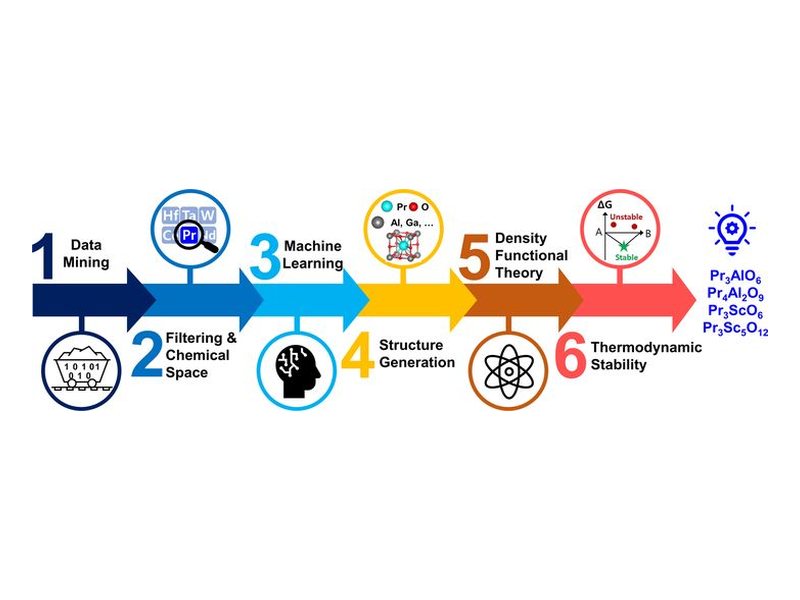
Data-based solutions, prediction and optimization, searching a massive parametric space — the route to empowering predictability.
Predict, resolve and optimize material issues — and accelerate material discovery.
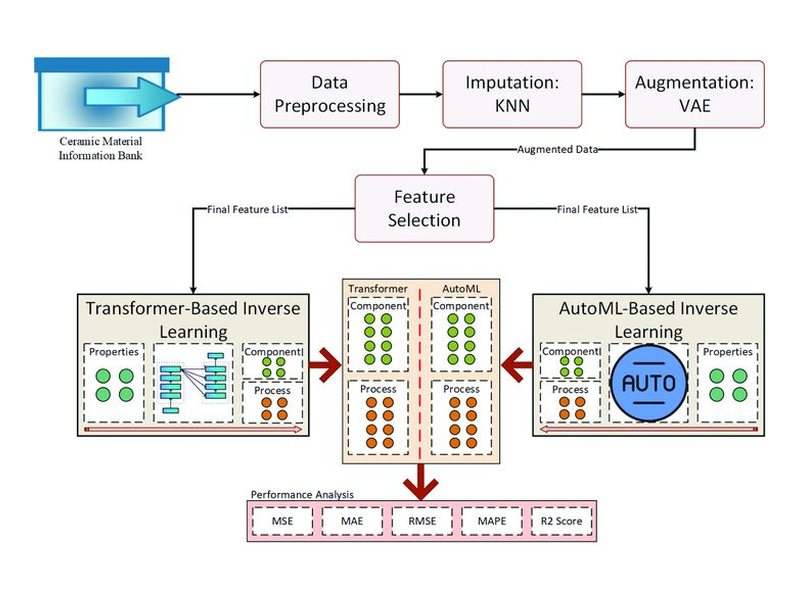
The lab in one diagram: model-driven analysis on top, data-driven prediction below, both feeding the same decision.
at a glance
News
What the lab has been up to
Press coverage, awards, conferences and the papers that made a cover — newest first.
Research
From electrons to reactors
A materials model earns its place when it does three things: understands what an experiment saw, predicts what no calculation can reach directly, and discovers the next material before anyone fires a furnace. The lab is organised around those three verbs.
research topics
Our research is organised around those three verbs: understand, predict and discover. We combine first-principles calculations, machine-learning force fields and multiscale simulation with small experimental data, and apply them across dielectrics, energy materials, catalysts and ceramic composites.
실험이 본 것을 이해하고, 직접 계산이 닿지 않는 것을 예측하고, 가마에 불을 넣기 전에 다음 소재를 발굴하는 재료 모델을 연구합니다. 제일원리 계산, 머신러닝 역장, 멀티스케일 시뮬레이션을 적은 실험 데이터와 결합해 유전체, 에너지 소재, 촉매, 세라믹 복합재에 적용합니다.
Understanding the Mechanisms Behind What Experiments See
실험이 관측한 현상의 메커니즘 규명
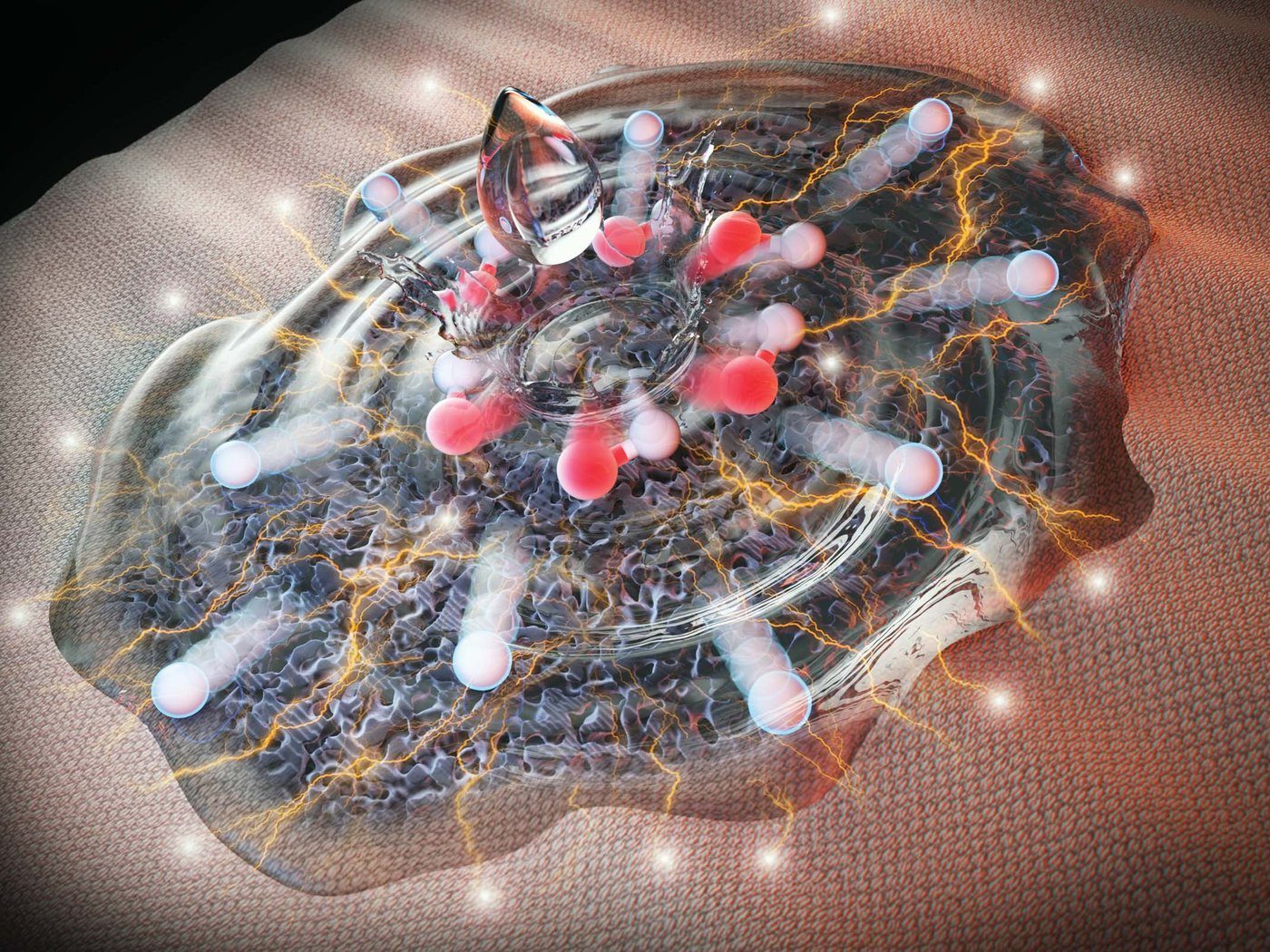
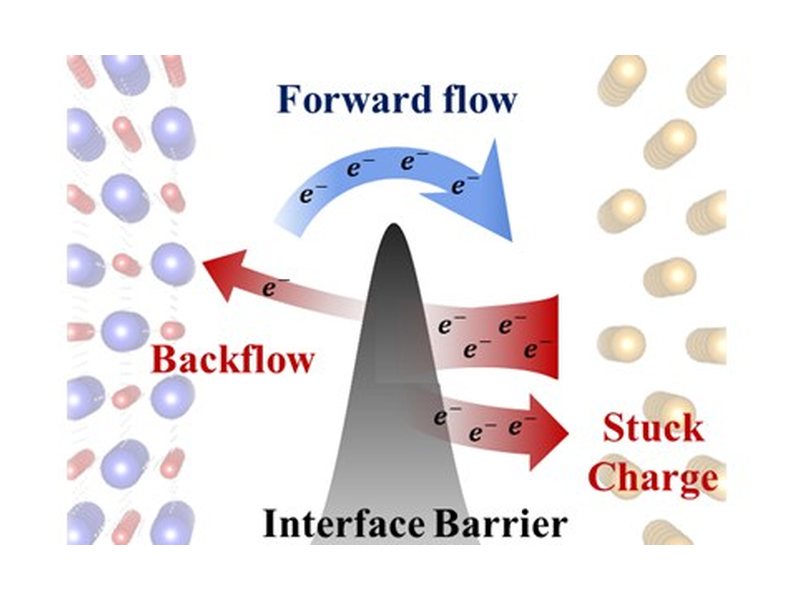
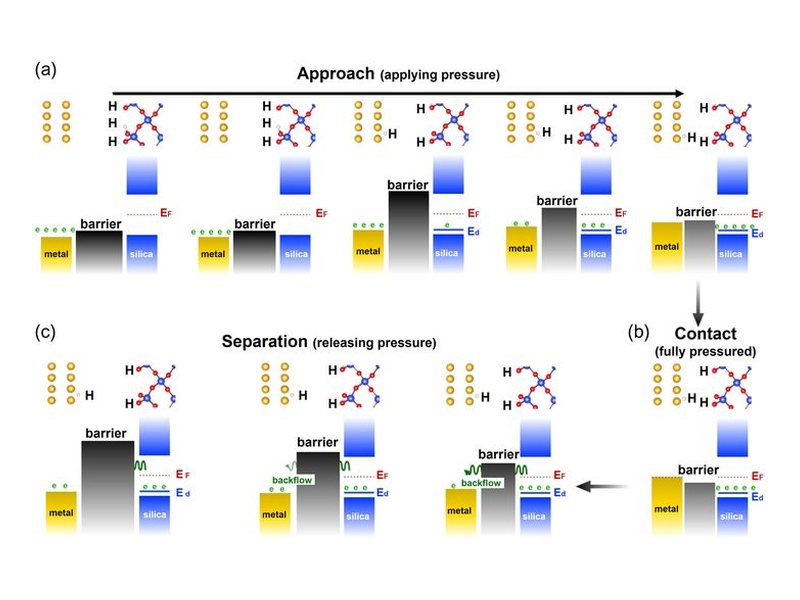
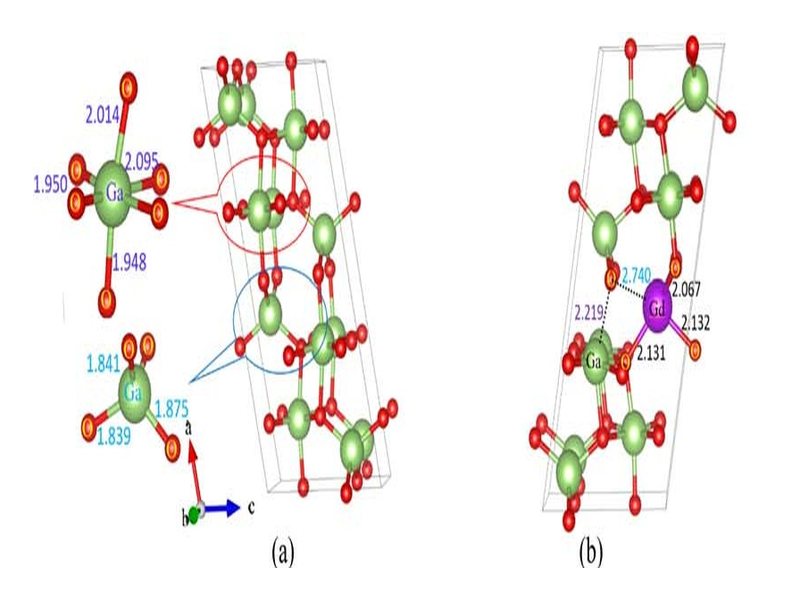
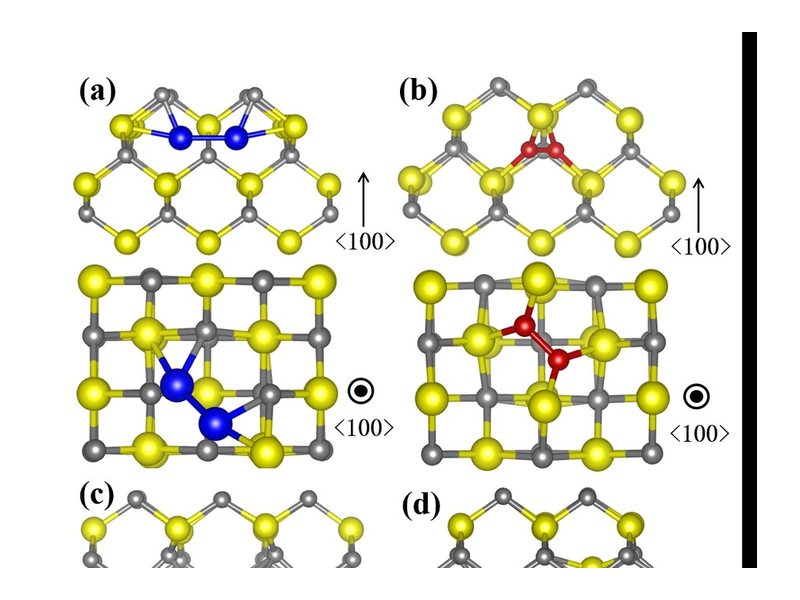
Experiments often record an effect they cannot explain. We resolve it at the scale the measurement cannot reach, then propose the experiment that tests the explanation. In colloidal quantum-dot infrared photodetectors, ultrahigh gain turned out to be a competition between impact-ionisation generation and inter-dot hopping, not generation alone. A device model built on DFT parameters reproduced the measured J–V curves and singled out the optimal ligand, and a photoluminescence measurement we proposed confirmed the trade-off. The same question has been asked of electricity from water in porous carbon, charge transfer at triboelectric interfaces, and catalysts whose best composition shifts with operating conditions.
실험은 현상을 기록하지만 그 원인까지 설명하지 못하는 경우가 많습니다. 측정이 닿지 않는 스케일에서 원인을 규명하고, 그 설명을 검증할 실험을 제안합니다. 콜로이드 양자점 적외선 광검출기의 초고이득은 캐리어 생성만의 문제가 아니라 충돌 이온화에 의한 생성과 양자점 간 호핑 사이의 경쟁이었습니다. DFT 파라미터 기반 소자 모델이 측정된 J–V 곡선을 재현하고 최적 리간드를 짚어냈으며, 제안한 광발광 측정으로 이 상충 관계가 확인되었습니다. 같은 질문을 다공성 탄소에서 물이 만드는 전기, 마찰전기 계면의 전하 이동, 작동 조건에 따라 최적 조성이 달라지는 촉매에도 던져 왔습니다.
Predicting Behaviour Beyond the Reach of Direct Calculation
직접 계산이 닿지 않는 거동의 예측
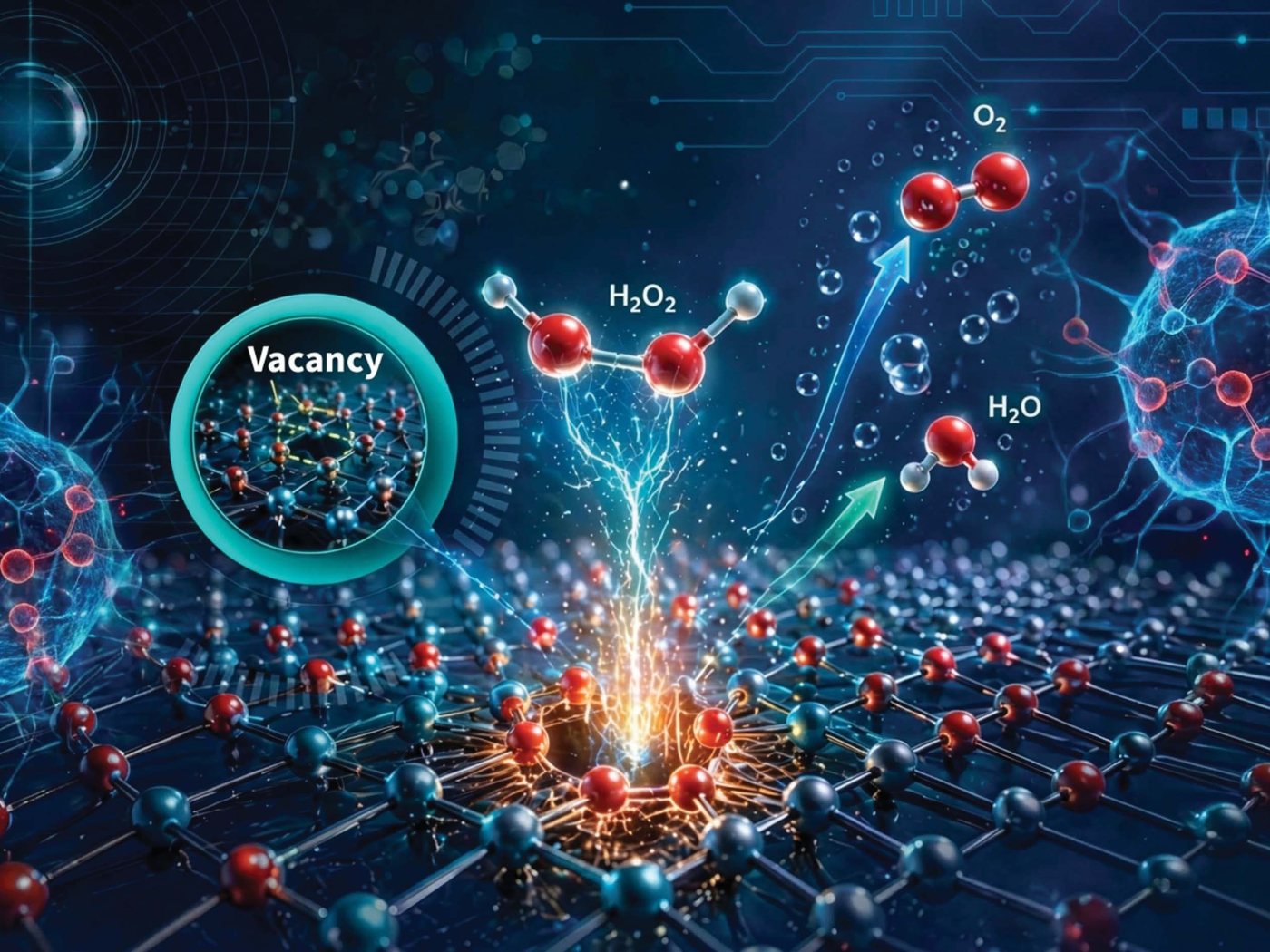
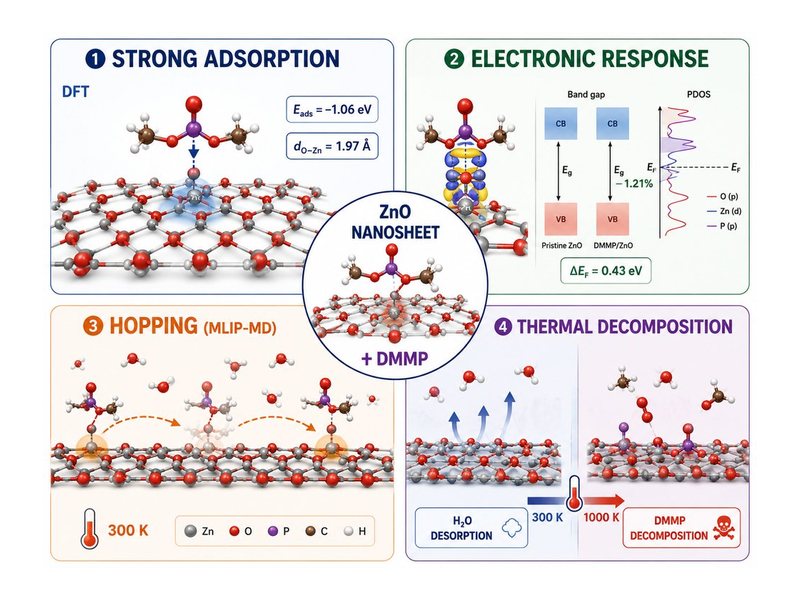
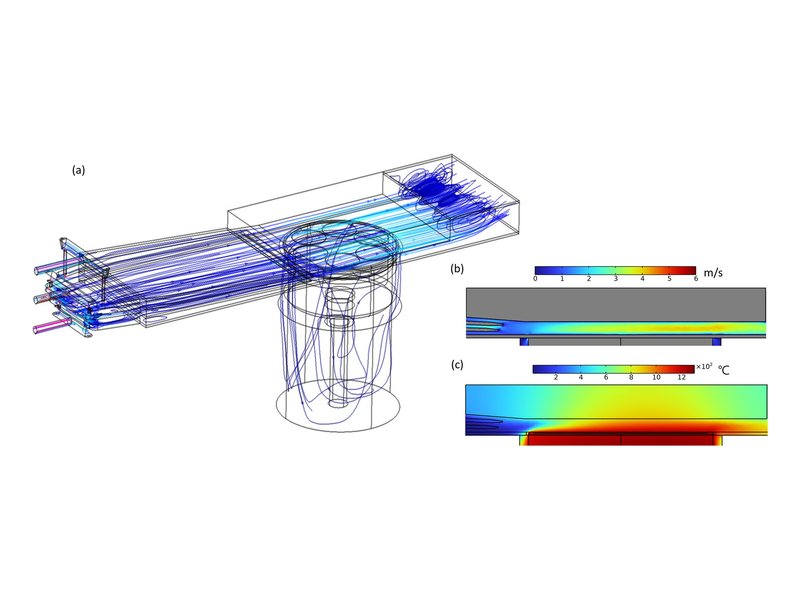
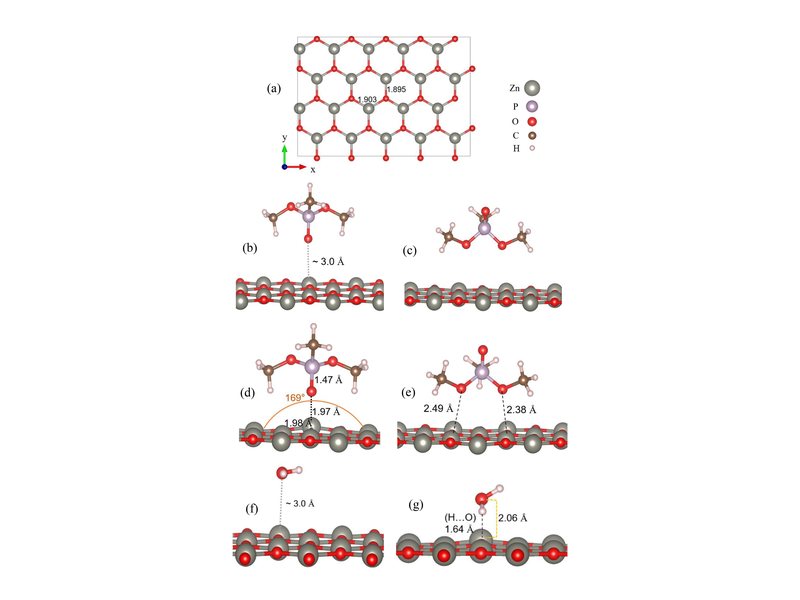
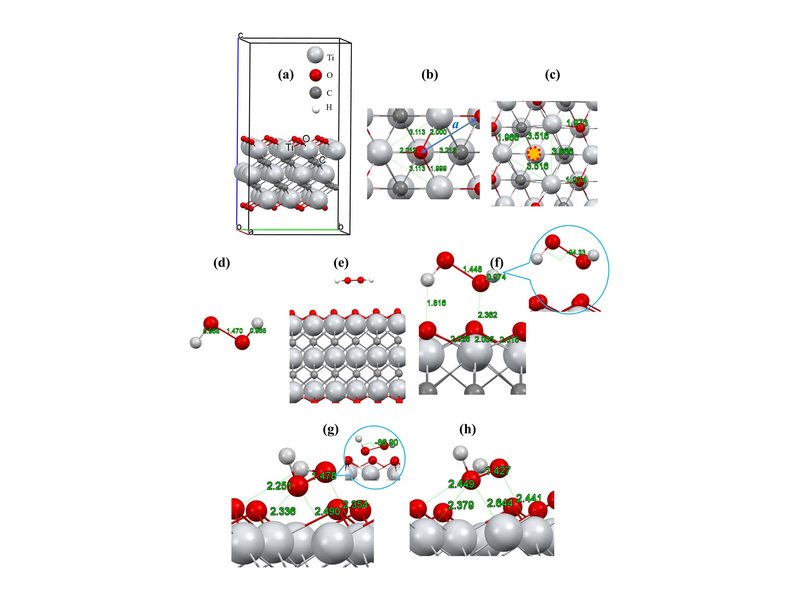
DFT is accurate but small; classical force fields are large but chemically blind. System-specific machine-learning force fields, trained on the fly where the model is uncertain, carry DFT accuracy to molecular-dynamics scale. They opened the vacancy-driven H2O2 dissociation path on MXene in water, and followed a chemical-warfare-agent simulant on a ZnO sensor from adsorption to decomposition as it was heated to 1000 K. In amorphous solids, where no single diffusion path exists, empty space is read as a graph of chambers and channels, so superionic candidates can be screened from structure before any expensive MD. Further up the ladder, simulation is turned on the equipment itself: HVPE and MOCVD deposition reactors are modelled for concentration, velocity and temperature fields, and horizontal MOCVD reactor layouts are tuned in simulation for film uniformity before hardware is built.
DFT는 정확하지만 다룰 수 있는 규모가 작고, 고전 역장은 규모는 크지만 화학 결합의 변화를 반영하지 못합니다. 모델이 불확실한 지점에서 즉석으로 학습하는 계 맞춤형 머신러닝 역장(MLFF)으로 DFT 수준의 정확도를 분자동역학 규모까지 넓힙니다. 이 방법으로 물속 MXene 표면에서 공공(vacancy)이 매개하는 H2O2 해리 경로를 밝혔고, ZnO 센서 위 화학작용제 모사체가 1000 K까지 가열되는 동안 흡착부터 분해까지의 과정을 추적했습니다. 확산 경로가 하나로 정해지지 않는 비정질 고체에서는 빈 공간을 방(chamber)과 통로(channel)의 그래프로 읽어, 비용이 큰 MD에 앞서 구조만으로 초이온전도체 후보를 선별합니다. 스케일을 더 올리면 장비 자체가 시뮬레이션 대상이 됩니다. HVPE·MOCVD 증착 반응기의 농도·유속·온도장을 모델링하고, 수평형 MOCVD 반응기 배치를 장비 제작 전에 시뮬레이션으로 조정해 박막 균일도를 높입니다.
Data-Driven Discovery: Few Experiments, Many Simulations, One Design
적은 실험과 많은 시뮬레이션을 결합한 데이터 기반 소재 설계
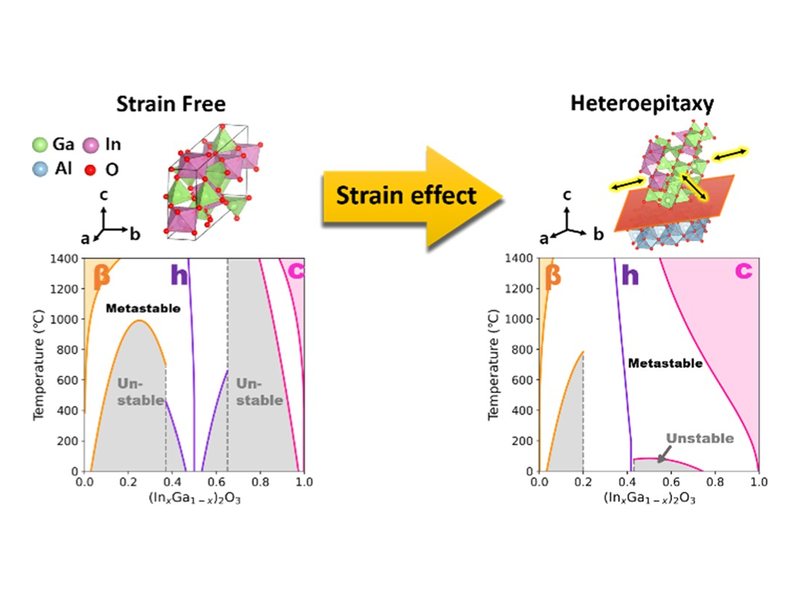
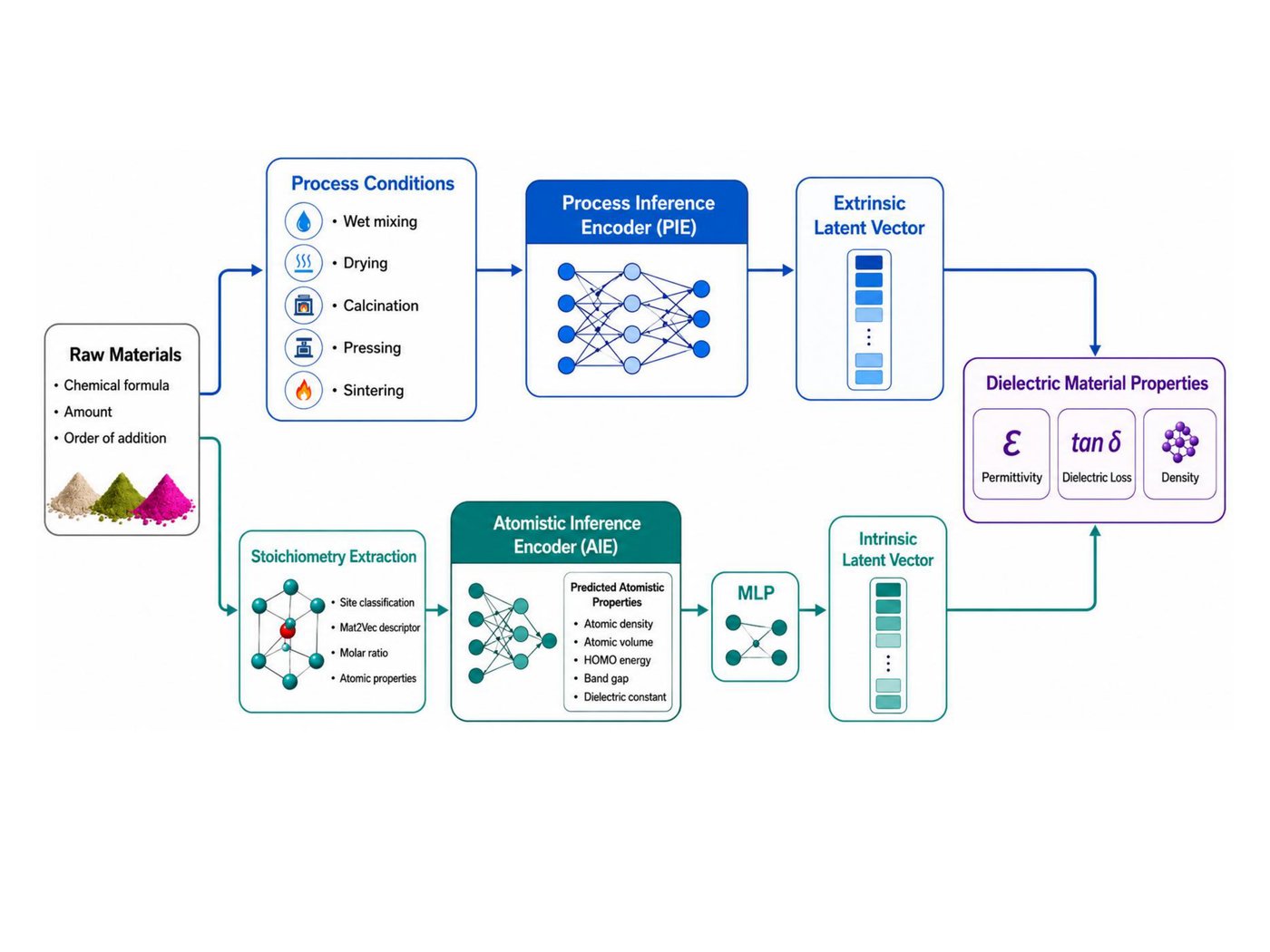
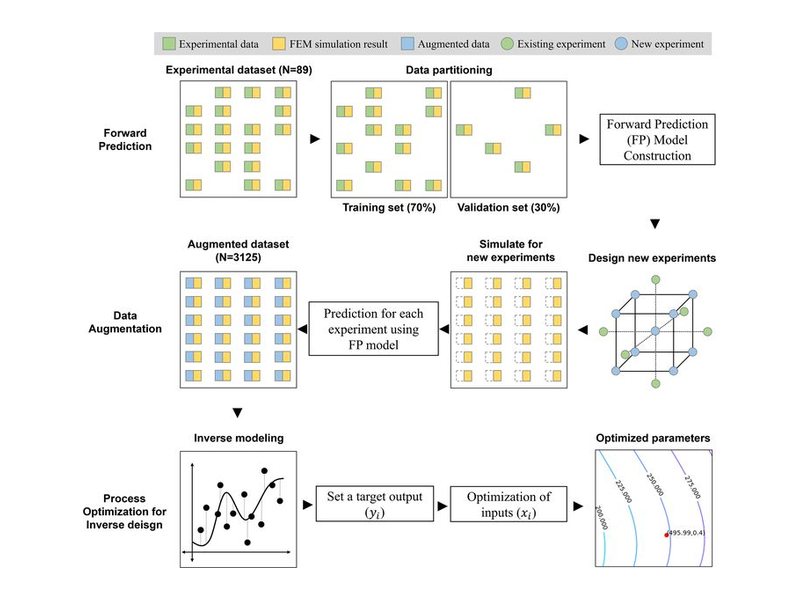
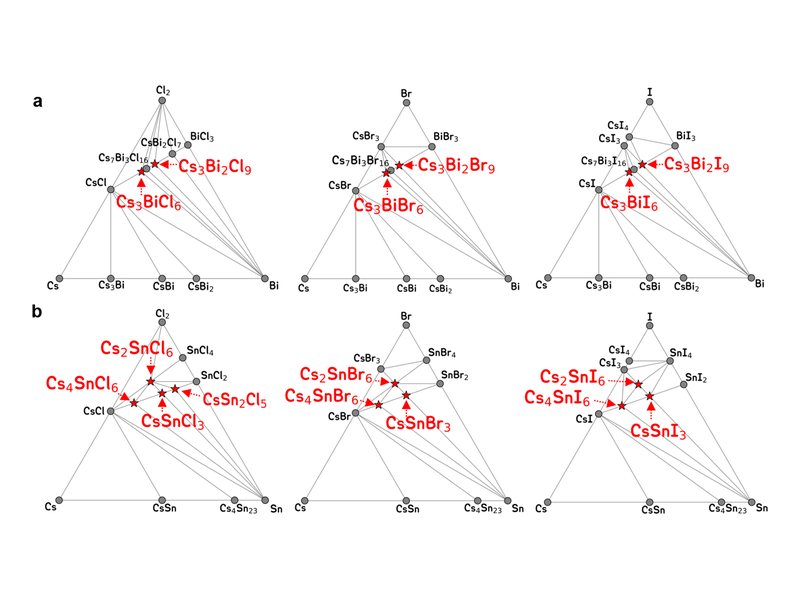
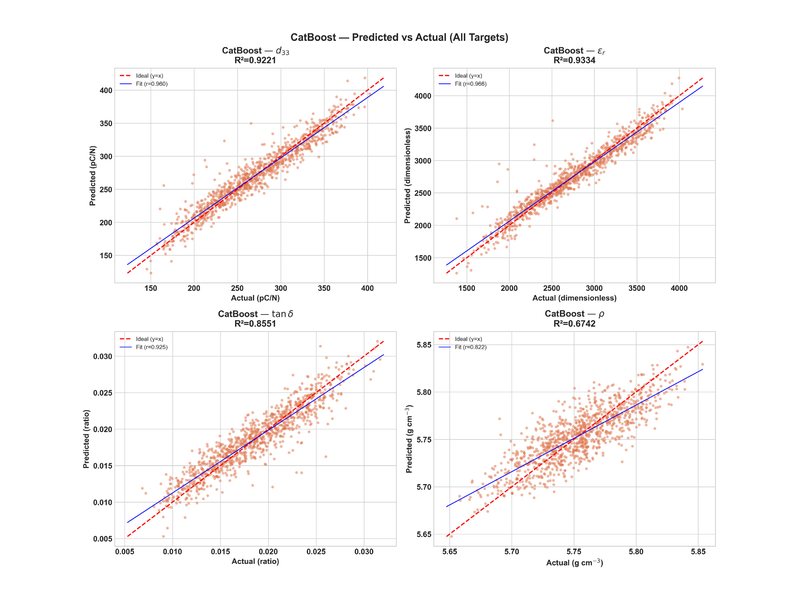
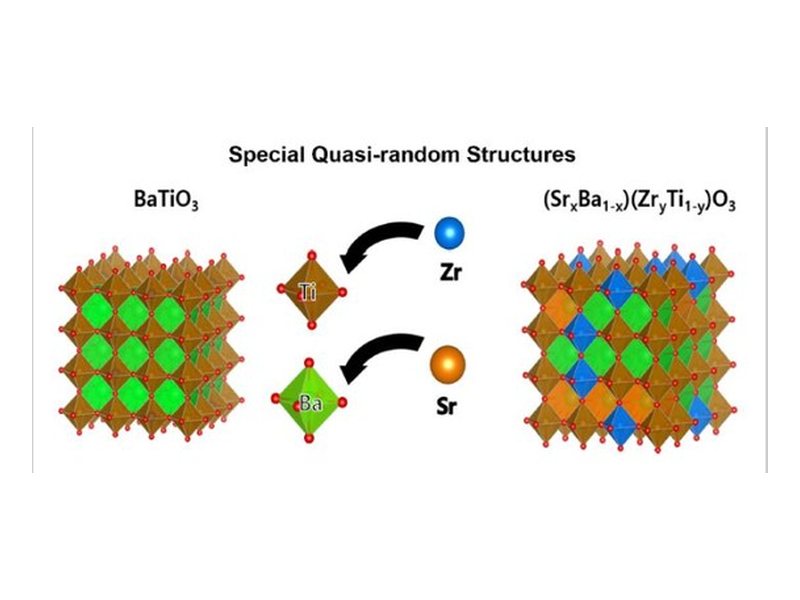
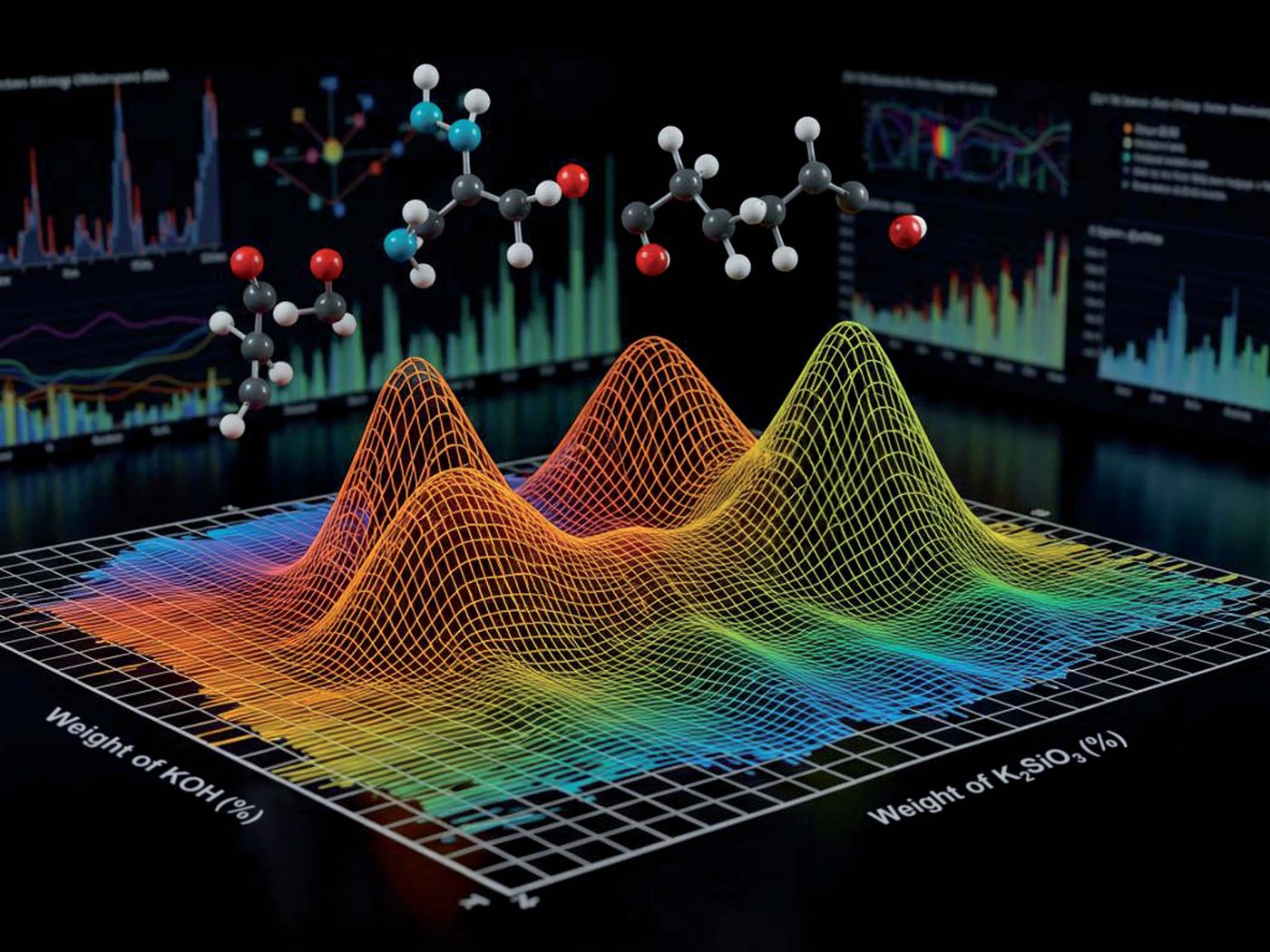
Experiments give roughly a hundred data points; simulation gives two hundred thousand. Hybridising the two is the lab's signature move. On ceramic tape casting, the core process behind MLCCs, physics-imitating networks trained on simulation reached R² above 0.9 with only about forty experimental data points. The idea is now being extended to a single network that reads composition and processing together. The same data-driven design runs across very different material classes, from BaTiO3 dielectrics and phosphors to lead-free halide perovskites and geopolymers, and is moving toward multi-fidelity and autonomous experiments.
실험으로 얻는 데이터는 100개 안팎이지만 시뮬레이션은 20만 개를 만듭니다. 이 둘을 결합하는 것이 연구실의 대표 방법론입니다. MLCC의 핵심 공정인 세라믹 테이프캐스팅에서는 시뮬레이션으로 학습한 물리 모사 신경망이 약 40개의 실험 데이터만으로 R² 0.9 이상에 도달했습니다. 이 아이디어를 조성과 공정을 함께 읽는 단일 신경망으로 확장하고 있습니다. 같은 데이터 기반 설계를 BaTiO3 유전체와 형광체부터 무연 할라이드 페로브스카이트, 지오폴리머까지 성격이 전혀 다른 소재군에 적용하고 있으며, 다중 충실도(multi-fidelity) 학습과 자율 실험으로 나아가고 있습니다.
Geopolymers and Ceramic-Matrix Composites, Studied End to End
지오폴리머·세라믹 복합재 — 한 소재계를 처음부터 끝까지
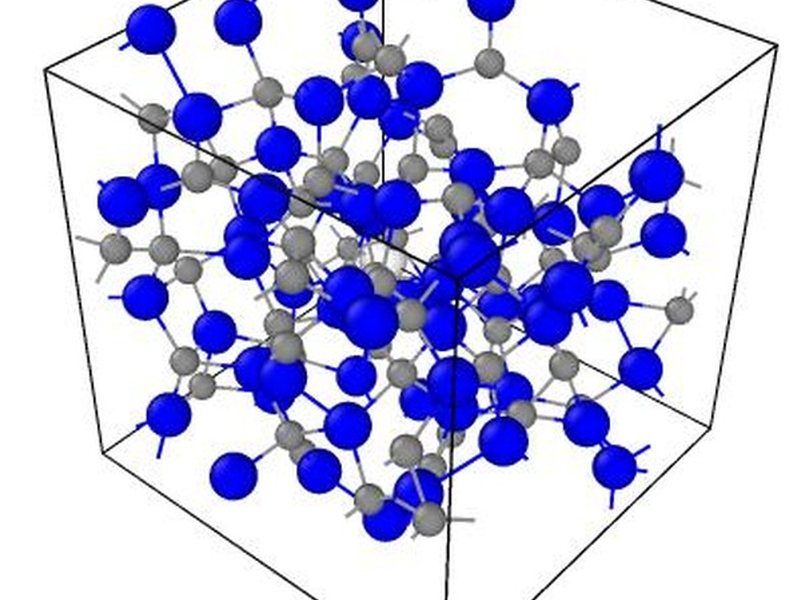
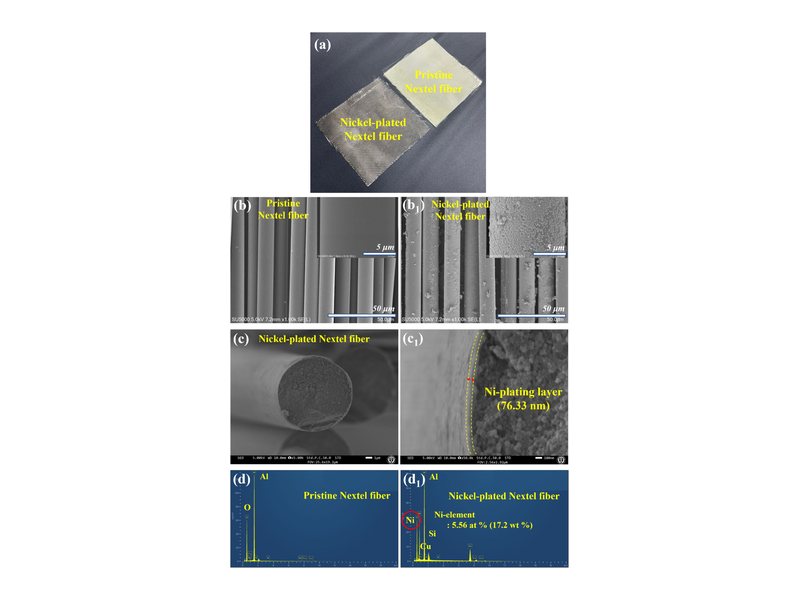
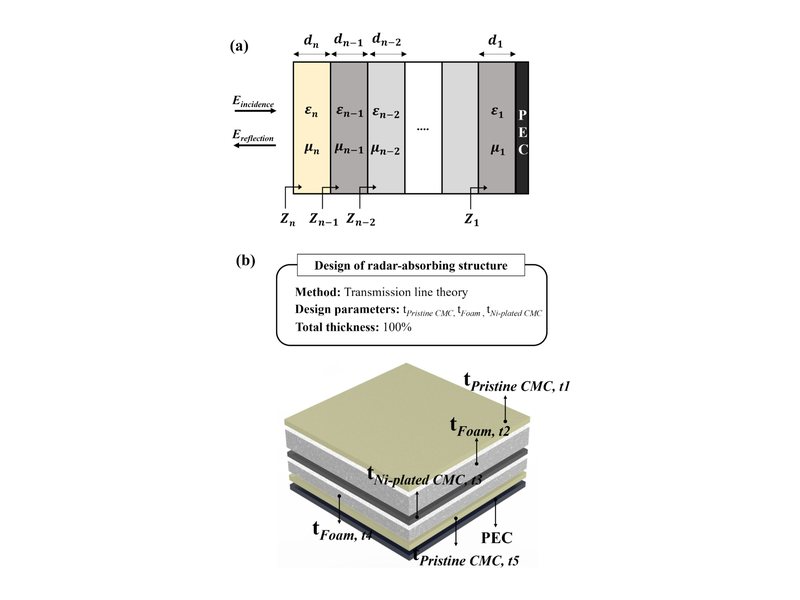
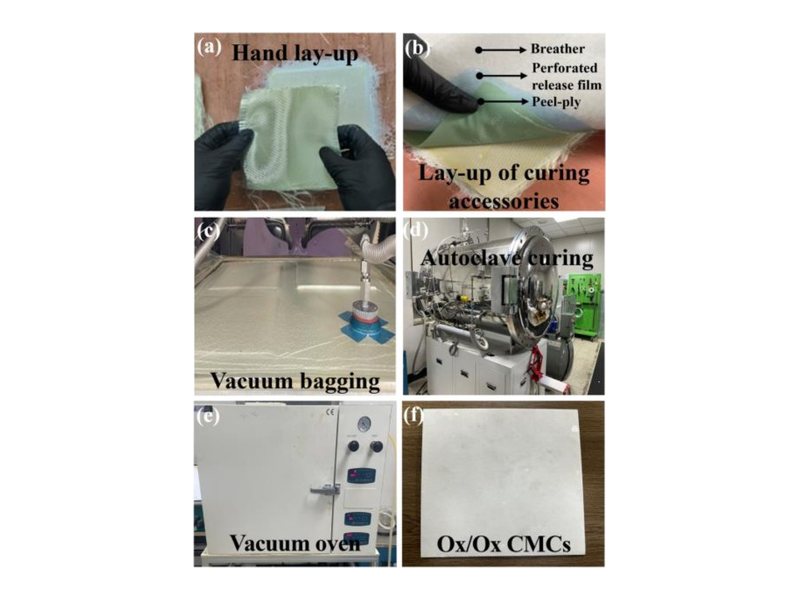
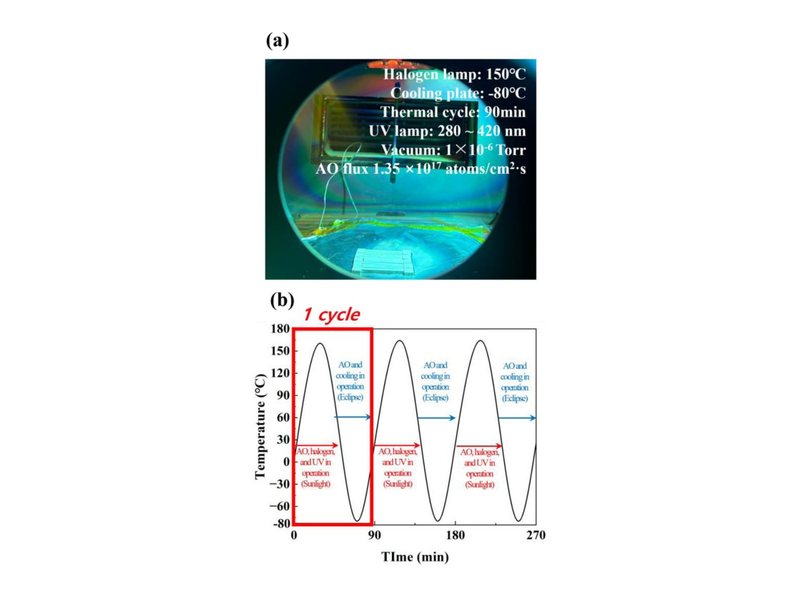
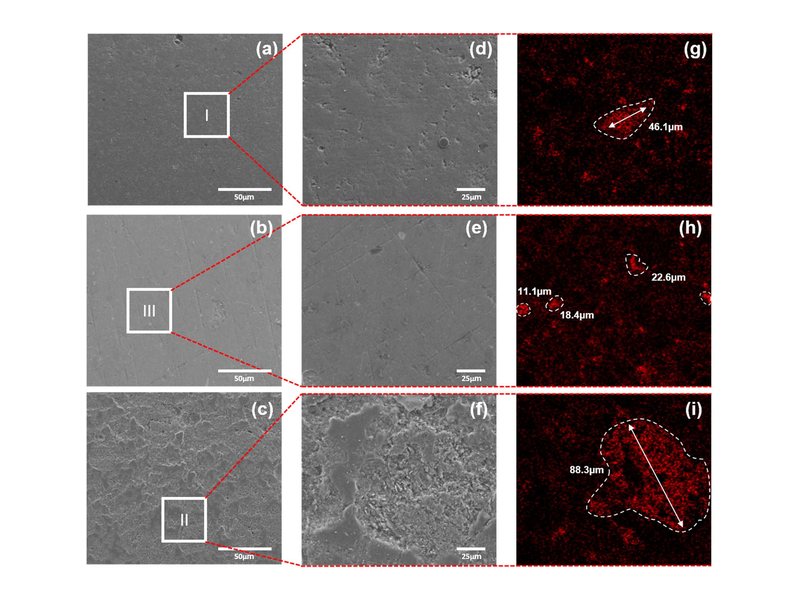
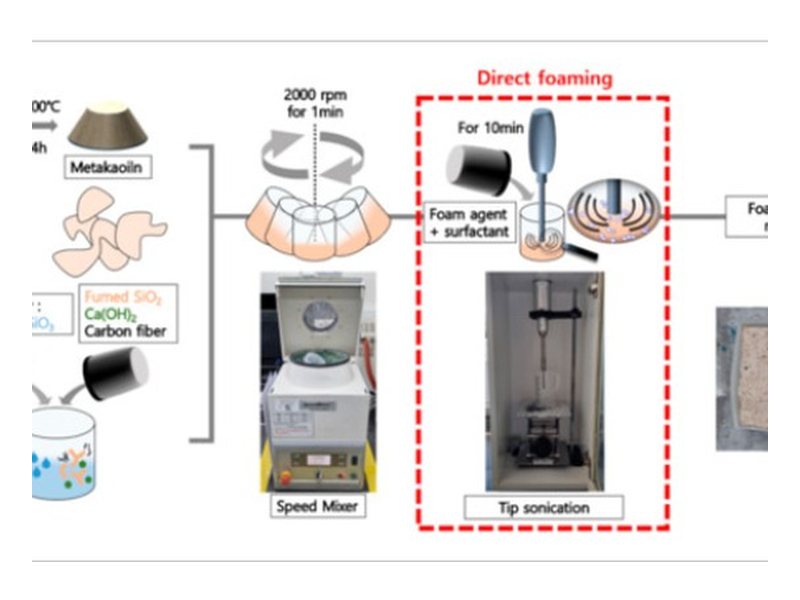
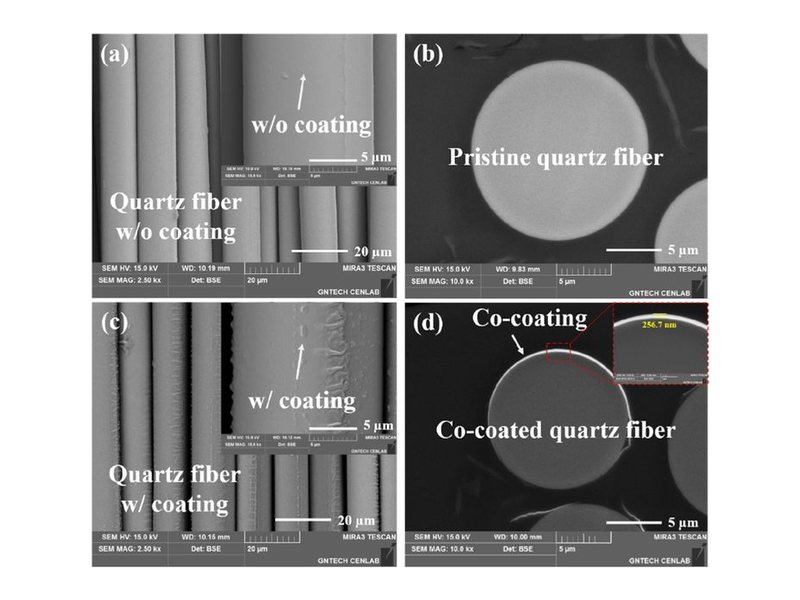
Inorganic binders and all-ceramic composites are the lab's longest-running materials system, from fast-curing geopolymers in 2019 to oxide/oxide composites built for very low Earth orbit. They are amorphous, multi-component and still largely made by trial, which is why understanding, evaluation and design all meet in them. We measure and then explain what the aluminosilicate is doing in a fibre-reinforced geopolymer (melt viscosity, fibre elasticity and the microstructure a filler leaves behind); with KICET's composite group, evaluate how the composites hold up, from atomic-oxygen damage in very low Earth orbit to radar absorption at ultrahigh temperature; and treat mix ratios as a solvable problem, using design of experiments and metamodel-guided optimisation to find geopolymers that cure at room temperature yet keep high flexural strength, and carry those matrices through to oxide/oxide composites made at low temperature and pressure. The work is done with KICET's composite and inorganic-binder groups, from mix design to hand lay-up, autoclave and mechanical testing.
무기 결합재와 전(全)세라믹 복합재는 연구실이 가장 오래 다뤄 온 소재계로, 2019년의 속경화 지오폴리머에서 초저궤도용 산화물/산화물 복합재까지 이어집니다. 비정질·다성분이면서 아직 대부분 시행착오로 만들어지기 때문에 이해·평가·설계가 모두 이 소재계에서 만납니다. 섬유강화 지오폴리머의 용융 점도, 섬유 탄성, 충전재가 남기는 미세구조를 측정하고 설명하며, KICET 복합재 연구진과 함께 초저궤도 환경의 원자산소 손상부터 초고온 전파 흡수까지 복합재의 내구 성능을 평가합니다. 또 배합비를 풀 수 있는 문제로 보고, 실험계획법과 메타모델 기반 최적화로 상온에서 경화되면서도 높은 굽힘강도를 유지하는 지오폴리머를 찾고, 이 기지를 저온·저압 공정의 산화물/산화물 복합재로 이어갑니다. 이 연구는 배합 설계부터 핸드 레이업, 오토클레이브, 기계적 시험까지 KICET 복합재·무기결합재 연구진과 함께 수행합니다.
Each rung answers what the one below it cannot resolve, and hands its result upward. The lab runs all four, and uses machine learning as the layer that carries information between them.
Electronic / atomic
Atomistic simulation
VASP Materials Studio
Micro
Molecular dynamics
LAMMPS
Meso / particle
Mesoscale modeling
GeoDict Rocky
Macro / continuum
Continuum mechanics
Ansys COMSOL
The same problem, four resolutions — and the solver stack that carries information between them.
People
Who runs the solvers
Eight researchers on the bench and six who moved on — split between physics-driven modelling and data-driven design.
principal investigator
Hyunseok Ko 고현석
Principal Investigator · Senior Researcher
Division of AI Convergence Research, KICET · 101 Soho-ro, Room 404 · +82-55-792-2553
Builds atomistic and data-driven models that explain why functional ceramics behave the way they do — and uses them to decide what to make next.
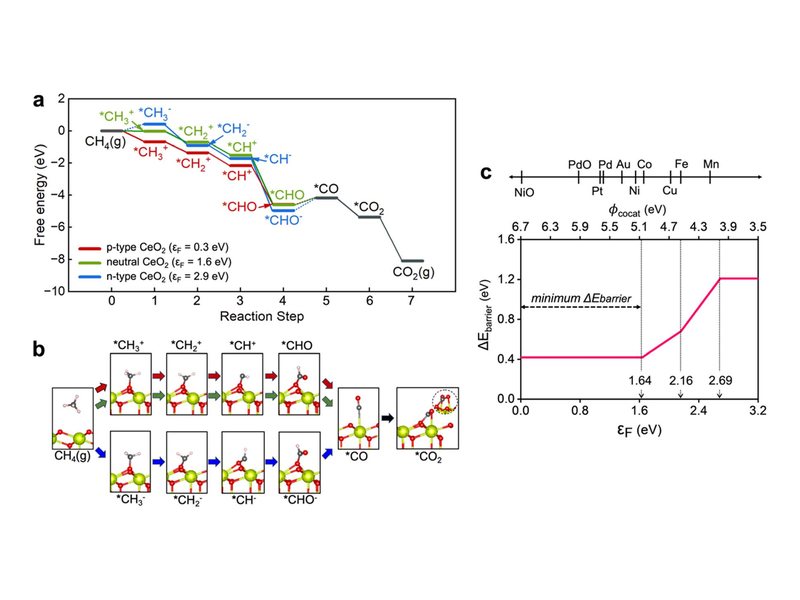
On the physics side, density functional theory resolves mechanisms that experiment alone cannot separate: vacancy-driven surface reactions, charge transfer at contact interfaces, dopant states in wide-bandgap oxides. On the data side, models map composition and processing onto measured properties, so a formulation decision can be made before the furnace is switched on.
The two halves are meant to be used together. Simulation datasets are large but idealised; experimental datasets are small but real. Much of the lab's recent work fuses them — hybridising a handful of measured samples with thousands of computed ones, and keeping the result interpretable enough that a materials scientist can argue with it.
Currently leading computational work on dielectric ceramics, energy-conversion surfaces, and inorganic composites. Organising committee, 9th Asian Materials Data Symposium (2026).
2017Ph.D., Materials Science & Engineering, University of Wisconsin–Madison Advisors: Dane Morgan, Izabela Szlufarska
2011B.E., Materials Science & Engineering, Illinois Institute of Technology
2011B.E., Materials Science & Engineering, Ajou University 아주대학교
Bold — MatSOLVE members ·
† first author · * corresponding author
Facility
Compute and codes
A cluster the lab owns outright, and a commercial solver stack that covers every rung of the scale ladder.
the compute floor
Everything below sits in the lab's own two rooms — 309 (high-performance computing) and 314
(AI computational engineering). Nothing here is shared time on someone else's queue.
31
Xeon-class compute nodes
12
NVIDIA A100-class GPUs
13
simulation workstations
16
commercial solver licences
Ceramic materials AI big-data solution — the lab's central cluster: 8 A100-class
GPUs and 14 Xeon-class CPU servers.
Beyond the cluster — 17 further Xeon-class server nodes, 3 more A100-class GPUs,
and one Blackwell-generation RTX Pro 6000.
Kept running by an immersion-cooled rack, a 50 kW process chiller, two dedicated
precision air handlers, and 10 GbE switching behind the cluster's own firewall.
solver stack
VASP
Materials Studio
GeoDict
Digimat
ANSYS
ANSYS Fluent
COMSOL
PIAnO
HEpiGaNs
Gallery
Off the cluster
Conferences, group meetings, retreats and the occasional birthday cake — 16 outings, 2026 back to 2023. Open one to page through the rest of its photos.